
The Italian Art of Doing Less: What Passeggiata Teaches About Rest
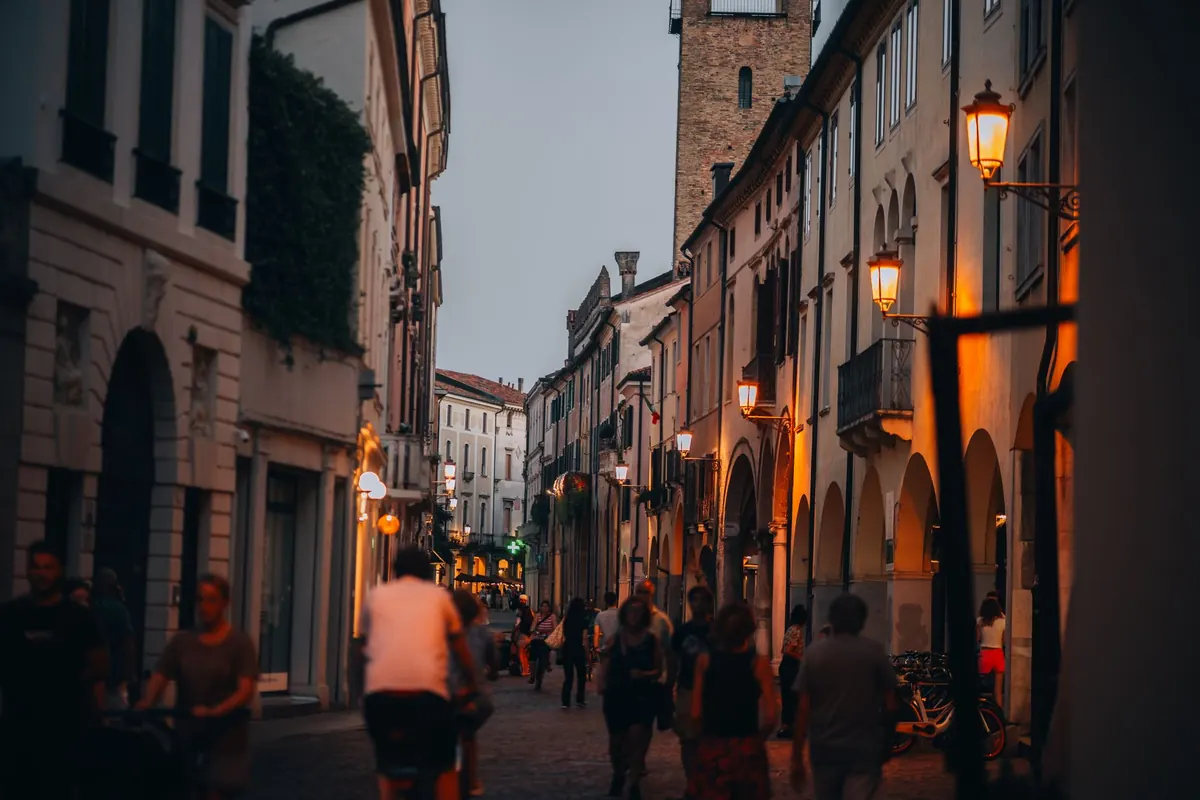
At half past six the shutters begin to lift. A bar owner drags a chalkboard onto the pavement, a woman in a good coat turns the corner with her husband, two boys on bicycles circle the fountain, then circle it again for no reason at all. By seven the street is full of people who are not going anywhere in particular. That is the whole point. The evening passeggiata is the most ordinary ritual in Italy and the least productive one. Watch it closely for a week and it turns out to be a fairly precise instruction in how to rest.
An Hour the Town Agrees On
Passeggiata just means a walk, but the word describes something narrower: the evening stroll through the centre of town, taken at roughly the same hour by roughly everyone. It is not a hike, not a training session, not a route with a viewpoint at the end. It is the Corso, the piazza, the street with the good shoe shop, and then home again.
The timing bends with the season. In January you see people out at half past five, wrapped up, moving briskly, home before dark. In July the same street fills after eight, when the stone has stopped giving off heat; children stay up, grandmothers take the good bench, and the walk stretches until the light goes. In the south it tends to run later and longer, in the north shorter and more purposeful. There is also the Sunday version, after Mass, with families in their better clothes and an ice cream before lunch.
It has thinned in some cities and lost ground to longer commutes and evening screens. But where it survives it is not a performance for visitors. Nobody is being picturesque. They are simply out, at the usual time, because that is what happens at the usual time.
The Route Goes Nowhere
Nobody walks the passeggiata to arrive. You go to the piazza, find it standing there as it always does, and turn around. On the way back you pass the same couple you passed fifteen minutes ago, and you greet them again, more briefly this time. Some people walk the loop three times. Nobody finds this strange.
Set that against how walking is usually framed now, with a number attached to it — steps, minutes, pace, calories. The passeggiata has no metrics. It also has no equipment, no warm-up and no destination. What it has instead is a shape:
- No distance to cover. The piazza is the end, and the end is the middle.
- No pace. Stopping is normal. Standing still for ten minutes to talk is also normal.
- No errand. If you need bread you go earlier, separately, on the way.
- No purpose beyond being on the street while everyone else is.
That last point is the difficult one for anyone raised to believe a walk should justify itself. It does not have to. The loop is the activity.
You Change Before You Go
There is a dress code, though it is gentler than it sounds. Not formal — clean. A shirt instead of the top you cleaned the kitchen in. Different shoes. A comb. The older men in some towns still wear a jacket in September, which is less about vanity than about habit.
The four minutes it takes to change are doing quiet work. They mark a seam in the day. Without that seam, the afternoon slides into the evening, which slides into a screen, and by ten o'clock you cannot quite remember what you did after work. The passeggiata works partly because it refuses to let the day be one undifferentiated block. You stop working, you wash, you put on something presentable, you go out, and by the time you come back the evening belongs to you rather than to the remainder of the afternoon.
The Point Is the Greeting
You will not talk to your closest friends on the passeggiata. You will talk to people you know slightly: the man from the hardware shop, your neighbour's sister, the woman whose dog you have met but whose name you have never quite caught. Each exchange lasts about two minutes and covers small, factual things — the weather, the road works, someone's knee, a son's exam results. Then one of you says dai, ci vediamo, and you both walk on, and nobody is offended.
This is not networking and it is not a party. It is the low-grade maintenance of a place. What makes it unusual is who is present: a grandmother on a bench, teenagers on the church steps, toddlers weaving between legs, a man in his seventies arguing about football with a boy of fourteen. Almost no other hour of the week puts those people on the same pavement with nothing organised between them.
That mixing is also the part hardest to reproduce alone. Which is why it helps to remember what the passeggiata actually asks of you: not conversation, just recognition. A nod to the person sweeping their step is enough to start.
Rest That Doesn't Have to Be Earned
Most of us treat rest as a settlement. The work gets finished, the inbox gets cleared, the kitchen gets wiped, and then we permit ourselves to stop. The trouble is that the list never quite ends, so the permission never quite arrives.
The passeggiata runs the other way round. The hour is fixed. The work is not finished. People go out anyway — the shopkeeper who still has invoices, the student with an exam on Monday, the mother who has not yet started dinner. At half past six the street fills regardless of anyone's to-do list, and that collective timing is the real mechanism. When everyone is out walking, nobody has to explain why they are not working. The rest is public, scheduled and short.
That is the transferable lesson, and it holds whether you live in a hill town or a suburb with no piazza: rest sticks when it has a time, a boundary and a small amount of company. It does not stick when it is the thing you do once everything else is done.
Building Your Own
You do not need Italy to run the experiment, though you do need to be a little deliberate for the first fortnight. Keep it small.
- Attach it to a fixed cue. Not "when I finish", which never comes. The light changing, the end of the working day, the hour before dinner. Same cue every day.
- Choose a short loop, ten to twenty minutes. Something with a bit to look at — a square, a row of shops, a bridge. The route should be dull enough that you stop treating it as an event.
- Change first. Wash your face, put on proper shoes, leave the house clothes behind. Two minutes is enough to separate the day from the evening.
- Leave the useful things at home. Phone in a pocket, not in your hand. No errands folded in. The moment it becomes a delivery run, it stops working.
- Greet one person. A nod, a good evening to whoever is at their door. If nobody is about, greet the same building you pass every night and go home.
- Go out even when you don't feel like it, and stay out even if you meet nobody. The appointment is with the hour, not with the crowd.
Fifteen minutes done most evenings will do more than an hour attempted once a week. Rest of this kind is not a reward you save up for; it is a small appointment you keep. The street does not need to be full of your neighbours for it to work — but it does need to be the same street, at the same hour, often enough that going out stops being a decision.
Photo: urtimud.89 / Pexels